
IoT product and technology solution provider

Phosphine (PH₃) Sensor Selection Guide: How to Choose the Right Gas Monitoring Solution for Your Application

August 31 , 2026


Phosphine (PH₃) is a colourless, pungent and highly toxic gas, as well as a strong reducing agent. Its toxic threshold limit value (TVL) is below 0.3 ppm. Any leakage can cause severe damage to the central nervous system. For this reason, real-time phosphine monitoring is critical for industrial safety, agricultural production and environmental protection.

With numerous PH₃ sensors available on the market, how do you make the right choice? This practical selection guide covers key dimensions to support your decision-making.

1. Define Your Application Scenario: Range and Accuracy Requirements Vary Widely

PH₃ sensors are mainly deployed in three major fields, each with distinct range and accuracy demands:
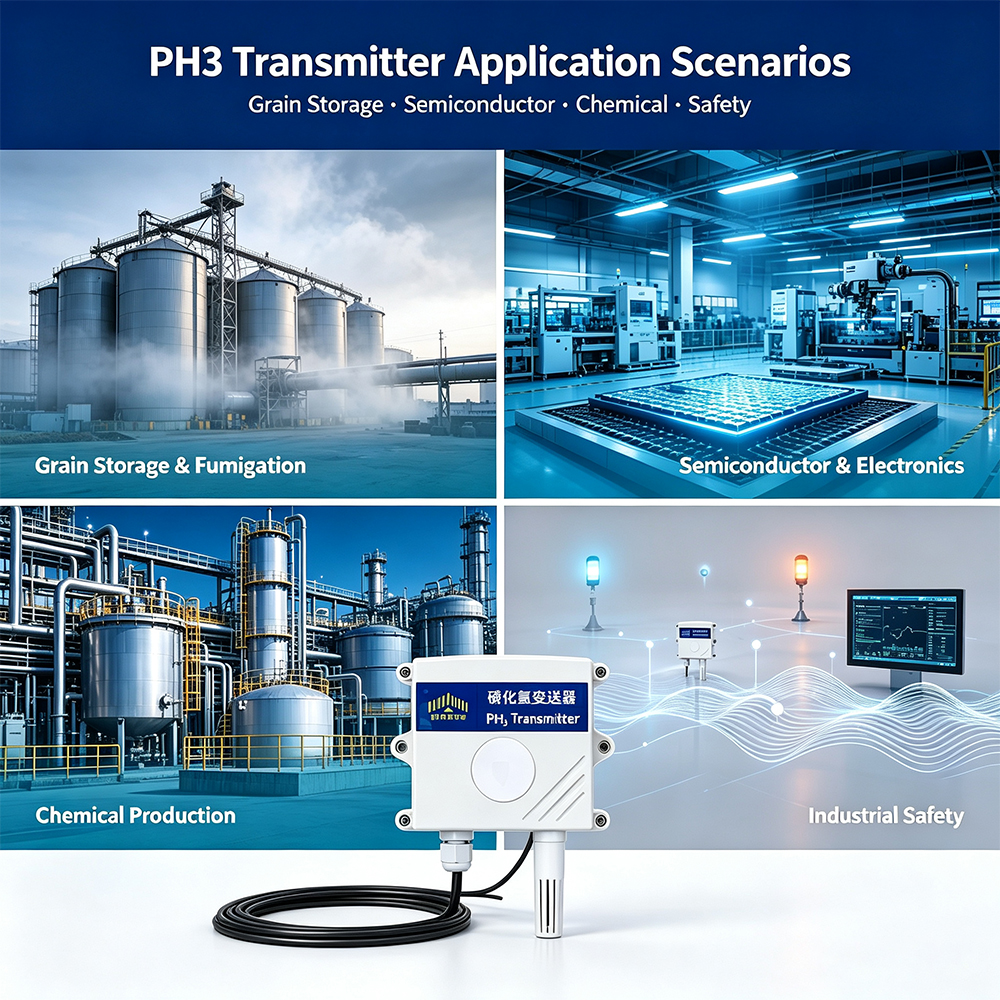

  • Grain storage and fumigation operations: This is the most traditional and widespread application for phosphine. Continuous PH₃ concentration monitoring is required during grain silo fumigation. Low-range sensors (0-10 ppm or 0-20 ppm) with excellent long-term stability are generally preferred for this scenario.
  • Semiconductor and electronics industry: Phosphine serves as an N-type dopant source for ion implantation and epitaxial growth on silicon wafers. Semiconductor cleanrooms impose extremely high standards for gas purity and safety, calling for high-accuracy, fast-response sensors.
  • Chemical manufacturing and industrial safety: Phosphine leakage risks exist during the handling, storage and transportation of phosphide compounds. Wide-range sensors (0-1000 ppm) with explosion-proof and waterproof industrial-grade construction are often required here.


2. Focus on Core Performance Metrics: Accuracy, Measurement Range and Response Time

Three technical parameters deserve close attention during sensor selection:


Metric

Description

Selection Recommendation

Accuracy

High-precision instruments typically feature errors of ±1%~±3% for reliable detection of trace leaks; low-precision units may show errors of ±5%~±10%.

High-precision models are recommended for safety-critical areas such as grain silos and chemical workshops.

Measurement Range

Common ranges include 0-10 ppm, 0-20 ppm and 0-1000 ppm.

Select according to the actual potential leakage concentration. Excessively large ranges will compromise low-end resolution.

Response Time

Industrial-grade PH₃ sensors normally achieve a T90 response time ≤ 60 s; premium models can reach ≤ 30 s.

Faster response enables early-stage alarm upon gas leakage.


3. Output and System Integration: RS485 + Modbus as the Industrial Standard

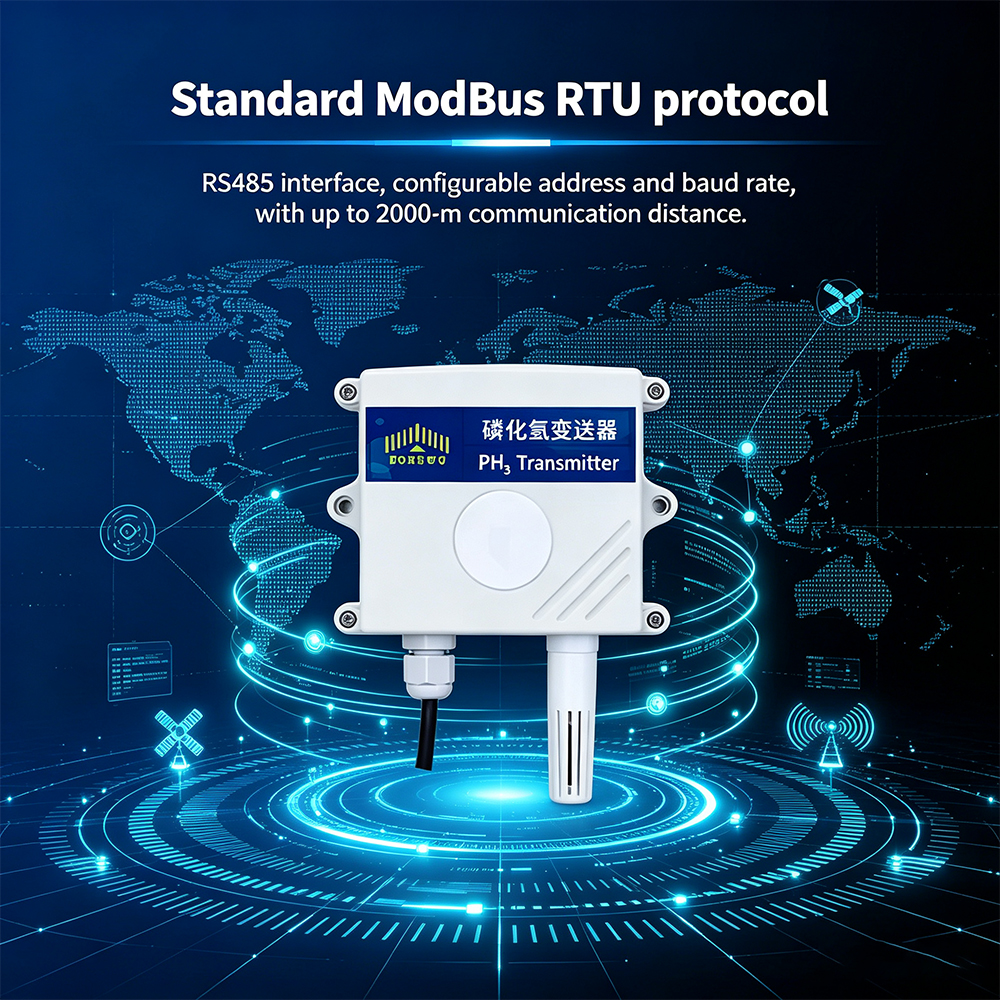
For industrial automation, sensor output directly determines compatibility with PLCs, DCS, industrial PCs and other systems. RS485 digital output paired with the Modbus-RTU protocol is the mainstream solution for industrial gas monitoring, offering the following benefits:


  • Long-distance transmission: RS485 supports communication distances over 1200 metres.
  • Multi-node networking: Bus-type connection supports multi-point monitoring deployments.
  • Strong anti-interference performance: Differential signal transmission suits harsh industrial sites.


For projects integrating with existing monitoring systems, prioritise RS485 + Modbus-enabled sensors to significantly reduce integration complexity and costs.
4. Environmental Compatibility: Waterproofing, Wide-Voltage Power Supply and Broad Operating Temperature Are Essential

PH₃ monitoring often takes place in harsh conditions: high humidity inside grain silos, corrosive vapours in chemical plants, and outdoor installations requiring dust-proof and waterproof performance. Pay attention to:


  • Ingress Protection (IP) Rating: Higher IP65 / IP66 / IP68 ratings deliver superior dust and water resistance.
  • Power-supply voltage: Wide-voltage input (e.g. 5-28 VDC) adapts to diverse on-site power conditions.
  • Operating temperature: Ensure stable performance across -20 °C to 50 °C.


Recommended Solution: PH3 (RS485) High-Accuracy Phosphine Sensor

Aligning with the above-mentioned selection criteria, the PH3 (RS485) phosphine sensor is a viable option:


  • Electrochemical principle: Adopts a three-electrode electrochemical cell. It precisely calculates gas concentration by measuring current generated via redox reactions of target gas on electrodes. This principle delivers high sensitivity and good gas selectivity.
  • Wide measuring range (0-1000 ppm) with high resolution (0.1 ppm): Covers high-concentration leak detection for industrial safety while providing fine resolution for low-concentration measurements.
  • RS485 + Modbus-RTU output: Directly connects to PLC, DCS and other industrial control systems for remote centralised monitoring.
  • 5-28 VDC wide-voltage power supply: Compatible with various on-site power sources.
  • Wall-mount waterproof construction: Suitable for demanding environments including grain silos and chemical workshops.


https://www.zonewuiot.com/rs485_c17


Assine nossa newsletter
Cadastre-se para receber as últimas notícias da nossa empresa!
Obtenha um orçamento gratuito
Se você estiver interessado em nossos produtos e quiser saber mais detalhes, deixe uma mensagem aqui e responderemos o mais breve possível.

Lar

Produtos

sobre

contato