
Categorias
Novo blog
Industrial Grade LCD Temperature & Humidity Sensor Selection Guide: Master These 7 Key Points to Avoid Pitfalls
May 19 , 2026
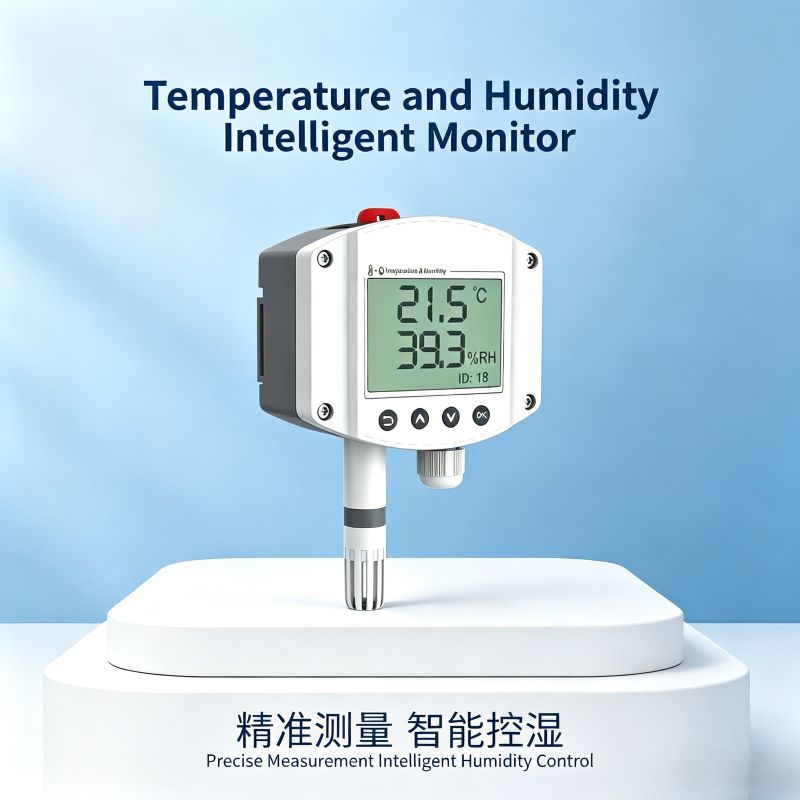
In industrial environmental monitoring, temperature and humidity sensors act as the "eyes" for air conditioning systems, computer room dynamic environment monitoring, warehouse management, power distribution rooms and other scenarios. However, products on the market come with complicated parameters. Improper selection will not only lead to inaccurate data, but also affect system stability. Combined with a typical industrial wall-mounted LCD temperature and humidity transmitter, this article sorts out 7 core selection tips to help you quickly pick the right model.
Prioritize sensors with temperature accuracy ≤±0.5℃ and humidity accuracy ≤±3%RH. For laboratory and pharmaceutical storage applications, select models with accuracy of ±0.3℃/±2%RH. Pay attention to annual drift as well. High-quality sensors feature humidity drift ≤1%RH per year and temperature drift ≤0.1℃ per year. Official datasheets clearly mark Class A and Class B accuracy grades and long-term stability indicators, which are core criteria to judge sensor quality.
Confirm the interfaces supported by your PLC or data collector:
Most industrial sites adopt DC 24V or DC 12V power supply. It is recommended to select sensors with wide voltage input range of 10~30V for wide compatibility. Lower power consumption is preferred. For example, devices with maximum power consumption of 0.4W reduce power load, and no high-power power supply is required even for parallel connection of multiple units.
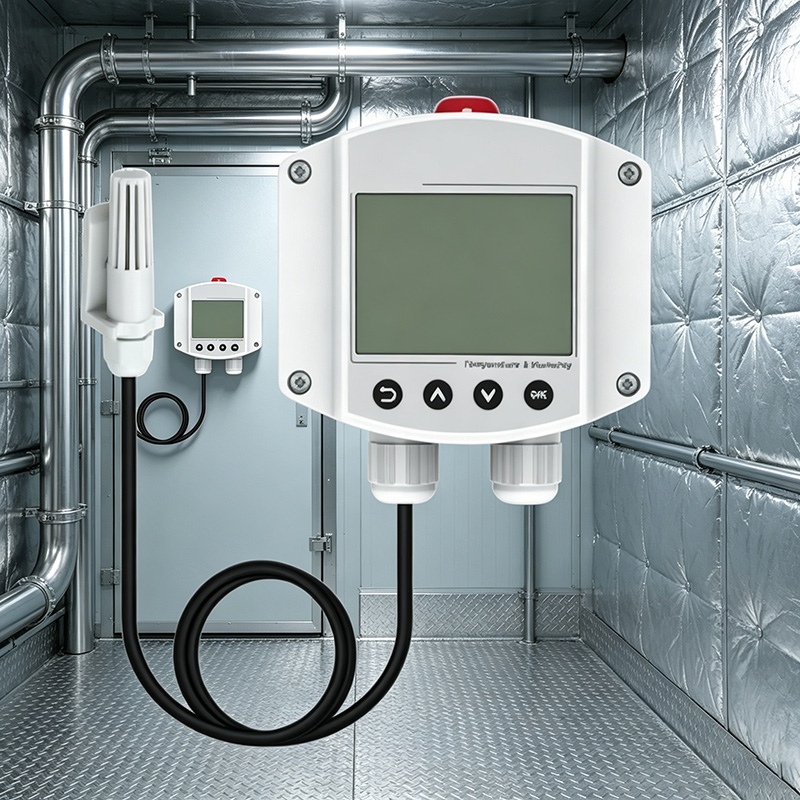
Check the mounting base: confirm whether it supports both wall mounting (70mm hole spacing) and 35mm DIN rail mounting. DIN rail installation fits electric control cabinets, while wall mounting is applicable to wall installation scenarios. The enclosure protection grade featuring dustproof and moistureproof performance is particularly essential for workshops and breeding farms. Industrial enclosures with sealed structure are highly recommended.
The LCD screen shall adopt high contrast and large font design without display delay under low temperature environments. Products equipped with physical keys and password protection allow users to modify addresses, baud rates and calibration values directly on site without connecting to a computer. The three-key menu with automatic parameter saving function greatly simplifies on-site debugging work.
Verify the operating temperature range of the circuit board (commonly -20~+60℃) and the detection temperature range of the probe (up to -40~+80℃ or higher). For cold storage and drying room applications, the probe must support ultra-low temperature down to -40℃ or high temperature up to +120℃. The humidity detection range shall cover 0~100%RH (non-condensing environment).
Standard ModBus-RTU protocol is the universal industrial communication standard. Ensure the manufacturer provides open register addresses to facilitate secondary development. Meanwhile, confirm whether the supplier offers dedicated configuration tools and communication demo programs to cut down development difficulty.
When selecting industrial grade LCD temperature and humidity sensors, do not focus merely on prices. Clarify on-site requirements including accuracy standard, output type, installation mode and extreme working environment first, then verify all items against official technical parameter sheets. Properly selected sensors can operate stably for years and greatly cut subsequent maintenance costs.https://www.zonewuiot.com/wireless-iot-sensors_c13

Tel : +86 18146178586
Whatsapp : +86 18146178586
E-mail : qui@zonewu.com
Adicionar : 1501-3, Building F03, Phase III, Software Park, Jimei District, Xiamen City, Fujian Province, China